Genevieve Doyle had a tremendous impact on Sam Walton's life. She helped Sam with his studies, she helped him improve his abilities to read and write, and positively influenced Sam in all aspects of his life. Sam had once told me a story of Genevieve and her unwavering bravery of the times (the 60's and 70,s) in Harlem. Genevieve wasn't afraid of much at all. Sam had told me of the time when he and a friend of his, Sam Gaynor, walked quite a ways through Harlem, with Genevieve in the middle of them both. See, Genevieve was white. She insisted she could walk by herself, but Sam and Sam had none of it, and escorted her anyway. That's the kind of man Sam Walton was - generous to everyone and giving back to his community of Harlem. I came across an old letter that was written to Genevieve many years ago, and here it is in its entirety:
Dear Sister Doyle,
It was great talking with you a few days ago. I am getting back to you to tell you more about the projects I mentioned.
We are grateful for the contributions you have made for the Dr. Mamie Clark and Ella Baker memorial. You are one of the earliest - and longest - of our supporters. It was due to you that the project was such a success in our early celebration. We were able to get Dr. Kenneth Clark and his family to attend. By spring, the city will have started refurbishing the square. Then we will add the benches, the trees, and the plaques as symbols of those two great women so that they will remain in our memory.
In addition, for the last five years we have been working on the Community History Project. It has been a struggle to get a proper focus and to raise the money. We know this project will be of great value to our community.
You have been a pioneer in your work in Harlem. Coming out of an elite Catholic Order, you built a bridge to our community. You did fantastic things for the children and for the adults. You brought hundreds of people to the theatre who had never been there. We want to record your interactions in Harlem. You are one of our heroes. We want to save this contribution for others to learn about. I am looking for someone to interview you for our oral history. Do you know someone there who can do it? Later, we will bring you back to Harlem to put it on visual tape. I would also appreciate any of the photographs you may have that will help document that experience. We really need them.
I will follow this up in a couple weeks so I can discuss this further with you.
From Sam, with love.
Monday, March 25, 2013

Friday, September 14, 2012
We Care Media Arts: How it All Started
THIS IS A LOOK INTO THE BEGINNINGS AND PURPOSE OF WE CARE MEDIA ARTS AND ITS MEANING TO HARLEM:
In the late 1960's, Dr. Mamie Clark, Director of Northside Center for Child Development, took under her wing two young men who had grown up in Harlem and helped them build a community based organization called We Care, devoted to helping the people of one Harlem neighborhood help themselves. Between 1969 and 1980, the organization succeeded in creating a walk-in center for the community to provide information about jobs, job training, health issues, housing and legal issues as well as help with many other problems.
It soon became apparent the community lacked a means of keeping its members informed. So We Care's young people published the first neighborhood paper to make the community aware of local events. This newspaper meant that youngsters were employing their talents to benefit their neighborhood. It was a vehicle for building leadership among the young people and by involving them with their community. The paper was published from 1973-1977. In the course of these years, the two young men, Sam Walton and Sam Gaynor, received a unique education and the activities of We Care were documented in the 1975 film called "Sam, Sam and Harlem".
We Care has been reconstituted as the We Care Media Arts Center to provide local Harlem teenagers with education and experience in the production of films and videos. The objective of the Center is to inspire Harlem's young people to use the screen as a means of self expression and to employ the documentary form as a means of accurately depicting life from their own perspective. We hope to encourage greater involvement in the community as well as provide practical skills and an opportunity to be creative. Possible projects include an exploration of Harlem's evolution over the past thirty to fifty years and the impact of urban renewal on the community. We would also like to produce short biographies of neighborhood achievers, exploring what it really means to be a hero. The Center would offer workshops on the technical and artistic aspects of producing documentaries.
We plan to begin with a pilot oral history project focusing on the neighborhood where Sam Walton, the executive producer of the media project, lived and where We Care was born. The period we will begin documenting spans some thirty years between 1950 and 1980. The focus will be on the St. Nicholas area from 130th Street to 145th Street between St. Nicholas and Seventh Avenue. A group of volunteers, a mix of professionals and students will work with us, trained by the staff of the Oral History Research Office at Columbia University. The work is being organized with the support of St. Nicholas Historical Committee with whom we are working to bring the community back together. Individuals on this committee will serve as volunteer interviewers to begin the project and later we will train young people from the St. Nicholas community to assist in the inerviewing and research process. Recently, we have begun working with students from the Thurgood Marshall Academy and the Bread and Roses Integrated Arts High School co-located, coincidentally, next door to the old We Care office.
Much of what we know of the history of Harlem is the broader and less personal factors that made, unmade, and remade the community over the years. We know little of the daily life of smaller areas of the community and those areas that represent continuity rather than abrupt change. We also do not know the detailed and long term effects of the various institutions of the community in that daily life. This pilot project is an attempt to start looking at the history of a community through the eyes of those who have played a vital role, both in the community and its institutional life. 9-29-98
Saturday, August 25, 2012
Harlem Headlines of the 1960's
HARLEM HEADLINES
Aug. 17, 1958 - The Savoy Ballroom, nightclub and one of the jewels of Harlem Renaissance, is closed.
July 4, 1959 - rent strikes break out over rat infestations, a liquor store whose owner refuses to buy from Negro wholesale liquor salesmen and a demand for improved bus service uptown.
Aug. 6, 1960 - Elijah Muhammad speaks to 8,500 Harlemites for two and a half hours at 369th Regiment Armory, calling Democrats and Republicans hypocrites. "Stop begging and licking the boots of White America!" he says.
Oct. 6, 1960 - Cuban Premier Castro Fidel and his entourage walk out of Shelburne Hotel in midtown and move to Hotel Theresa in Harlem, complaining of "unacceptable cash demands". Soviet Premier Nikita Khrushchev and Egyption Premier Gamal Abdel Nasser, also in town for United Nations conference, visit Castro.
June 30, 1963 - Martin Luther King's car comes under egg-throwing attack as a crowd gathers at Salem Methodist Church where King was on his way to speak. Police blame "Muslim sympathizers" for the attack.
Dec. 2, 1963 - Malcolm X says the assassination of President John F. Kennedy was "the chickens coming home to roost". Spoke at Manhattan Center. Black Muslim leaders rebuke Malcolm.
Dec. 7, 1963 - Amsterdam News reports 55 Harlem buildings are taking part in rent strike.
July 17, 1964 - James Powell, 15, of 1686 Randall Ave. in Harlem is shot to death by off-duty police Lt. Thomas Gilligan in Yorkville. Policeman says boy pulled knife. Thousands riot in Harlem for several days.
Feb. 6, 1965 - Malcolm X tells of an attempt on his life teh previous week in Los Angeles and says "my death has been ordered by higher ups in the Movement."
Feb. 21, 1965 - Malcolm X is assassinated during a speech at the Audubon Ballroom at 166th Street and Broadway. Police arrest Thomas Hagan and charge him with the slaying. Three people are wounded by some of the 30 rounds fired at Malcolm. Hagan is beaten and wounded by a bullet before police rescue him.
Nov. 14, 1965 - Martin Luther King gives sermon at Abyssinian Baptist Church, urging a negotiated settlement in the Vietnam and asserting that the Vietnam issue cannot be separated from the Civil Rights movement at home.
Feb. 12, 1966 - Amsterdam News reports that despite presence of a police precinct on the same block, merchants on 135th Street are forced to hire their own guards.
Sept. 3, 1966 - Black Panther Party holds membership drive on 125th Street as Student Non-Violent Coordinating Committee stages a rally featuring Stokley Carmichael, head of the organization.
Nov. 18, 1967 - Harlem on My Mind exhibit opens at Metropolitan Museum of Art.
April 5, 1968 - Sporadic violence breaks out in Harlem and in parts of Brooklyn over assassination of Martin Luther King. Mayor John Lindsay walks streets to urge calm but has to be hustled into Percy Sutton's limousine because of unruly crowd at 125th and 8th Ave. Lindsay returns to Harlem short time later. Members of HARYOU, NAACP, CORE, Harlem Cadets Corps and other groups are praised for roving neighborhoods for two days asking residents to keep their cool.
April 23, 1968 - Students take over much of Columbia University in protest against plans to build a gym in Morningside Park on border with Harlem. New York Times first editorial on the matter calls protestors "hoodlums".
Nov. 16, 1968 - Amsterdam News reports that thugs and addicts have brought on a reign of terror along 116th Street.
Nov. 3, 1968 - Rep. Adam Clayton Powell Jr. loses bid for reelection with Charles Rangel winning in a six-way race for the Democratic nomination. His defeat followed a Congressional attempt, later ruled unconstitutional, to deny him his seat in the House.
Sunday, August 19, 2012
New Breed of Street Preachers
NEW BREED OF STREET PREACHERS

Growing up, Sam realized and took notice to the changes in Harlem. This is an insight into the beginning of Sam's desire to seek change in his community.
When I would be coming home from school, our hallway seemed
to be a place where bookies would regularly come to count their money away from
prying eyes. Even I could tell they were
nervous. One guy in particular had eyes
that would almost pop out of his skull when I entered the building. The fact he would be so startled by a little
kid reflects how things were changing on the street: increasingly, these guys
themselves were being victimized by the growing numbers of desperate drug users
who had no hesitation in pulling a stick up. Those days mothers were fearful
for the safety of their kids on the street.
I don’t think my mother realized how dangerous things would soon become.
The bookies were everywhere.
This was a real local industry, though it was one I never bothered to
join. Across Eighth Avenue, from our
house, was Jimmy Clark’s pool room, and just down the avenue was the Mumble
Bar. Ernie’s brother, Ralph, owned the
Mumble Bar, and I recall him looking like a Puerto Rican Frank Sinatra. I spent loads of time wandering between the
two establishments and soaked into that scene for years. Jimmy Clark was what we later called a
racketeer, and yet he was my first real mentor. He was also a New York City bus driver, a
light-skinned, large frame man with straight hair – and yes, he fit my ideal
gangster-looking type. He appeared to be
thoughtful, quiet, and analytical. In between pool shots, I imbibed his street
smarts and soulful spirit, and watched all those up and coming street sharks
become community icons for the younger
crowd. There was nobody in the pool hall
Jimmy didn’t know and know everything about.
I recall a police raid
in Jimmy’s building and he even got arrested, which was a big status deal in
the community. Jimmy still seemed wise,
and in his pool hall was a chance for me to get a piece of that wisdom. So I learned about the world from Jimmy’s
vantage point. I learned to tell who was
bluffing and who would be good for their debts, just by their body
language. I learned who was in the
latest neighborhood crimes and who was making money. I also began to see how things were changing
in Harlem. The police were losing their
edge, confrontation was becoming the coin of social exchange, and people were
beginning to pay attention to politics, viewed through the lens of marginalized
and resentful observers. I began to see
a new breed of street preachers, usually ex- cons now sporting ties and black
suits, spreading the word about a strange, new religion and anger towards the
white man. It would be some years before
I came to understand what it all meant, seeing I was only thirteen or so.
Saturday, August 11, 2012
Harlem historian and filmmaker
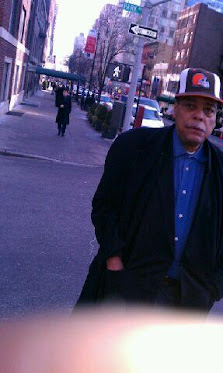
SAM WALTON –Filmmaker & Harlem Historian
 |
| 12/13/48 - 2/21/12 |
SAM WALTON –Filmmaker & Harlem Historian
(& regular customer at Sylvia’s Restaurant for Sunday breakfast)
Sam Walton was born on December 13, 1948, and raised in Harlem on 137thand 8th Ave. Growing up, Sam had reveled in stories of Harlem’s once glittering and sophisticated existence, even though the community he knew was a community crumbling apart. By the time he entered his teenage years, drugs had permeated and swallowed the people of Harlem. Sam Walton believed by investing in his community that others would remember and pass on a greater knowledge to those who have and will come after him.
Sam and his mother, Smyrna, along with his two brothers, Joe and Nick, lived in a very small third floor apartment. This was in the 60’s before the projects started to get shabby – a time when everything was well kept. As drugs seeped into Harlem, kids started tearing up places and hallways started reeking of disorder and stale urine. Family was always an important part of Sam’s life – Aunt Pauline who lived on the floor above and Aunt Mazaree and her husband who used to babysit for Sam and his siblings.
Sam’s first job working in Ernie’s Barbershop was an important milestone. He saved and saved until he had $8 to buy his first bicycle. That bike meant a lot to Sam – it was his first self-earned possession, his first means to tour the sights beyond that little corner of Harlem. No longer did he feel he would be standing on the corner watching the world go by. As Sam started to venture out, wandering the streets as an adolescent, he intently watched the street sharks becoming community heroes and icons, bookies overtaking the streets, and the ease with which people were sucked into the corrupt lifestyle. Law enforcement was losing its edge, and confrontation was becoming the coin of social exchange. People were beginning to pay attention to national politics, and Sam began to notice a new breed of street preachers now sporting ties and black suits and spewing an angry attitude.
In 1965, Sam signed up for the Job Corp,, where he was sent to Camp Kilmer in New Jersey for the training program. This is where Sam learned to take care of himself and wanted to dedicate himself to improve his roots – Harlem.
Sam Walton, and his friend, Sam Gaynor, had been living in a basement apartment. They were kind to neighborhood kids and even threw a huge birthday party for a neighborhood child who had never had a party before. The intangible reward Sam had felt for this generosity urged him forward in his mission to help his community. A few community groups had provided bus transportation to Bear Mountain and local trips to the parks in the city. Soon Sam and Sam were getting lots of attention from more established groups that were recipients of federal provisions. Emma Bowen, a leader in Washington Heights, put in a good word for them with Mamie and Ken Clark, organizers of the Northside Center who actually put in funds out of their own pockets for community services. A meeting ensued shortly after and they were on their way!
We Care Media Arts was founded in the late 1960’s to enable young people in Harlem to empower themselves through community service. Early accomplishments include a job preparation program and a community newspaper produced by local youths called City Scene. We Care Media Arts fosters a sense of pride by filming oral histories of long time Harlem residents and community leaders – emphasizing the cultural legacy and wisdom embodied by Harlem’s older citizens and spark inter-generational dialogue and positive community activism. HarlemTalking is a production of We Care Media Arts and introduces some of the men and women, from ordinary to famous personalities, who have lived and worked in Harlem. Some of the elite interviews include Charles Rangel, Percy Sutton, Basil Patterson, David Dinkins, and Ella Baker. The Youth Media/Leadership Program trains young people in communication skills, documentary filmmaking techniques, and introduces them to Harlem history.
Sam Walton put his mark on the community of Harlem by educating the youth and instilling in them a sense of pride and understanding of oral history, not to mention the skills learned while recording historical documentaries. His legacy will remain in the hearts of those he touched and taught – a priceless gift to Harlem.
www.harlemtalking.org
Wednesday, August 8, 2012
Sam, Sam and Harlem
SAM, SAM, AND HARLEM
A short movie was made by two young Harlem residents in 1973-74. It is rich in scenes of Harlem street life and traces the experiences of Sam Walton and Sam Gaynor as they organize a self-help community group called "We Care."In addition to tracing the history of this organization, there are many aspects of this film that make it of interest to historians, film makers, and ethnic sudies programs. Perhaps most striking are the documentary footage that show Harlem street life during the early 1970's. The movie begins, for example, with a scene of various dancers performing for an audience of children and residents of one Harlem block. In additioin to a dance troop performing traditional African dances to the beat of a drummer an elderly one-legged performer who has, by that time, thrown away his crutches while continuing to perform.
Scenes of street corner orators in front of Micheaux's book store provide unique footage of a side of Harlem life that is rarely seen. Lucille Levy, Malcolm X, Adam Clayton Powell, Charles Kenyatta, and Pork Chop Davis are all shown speaking to audiences in the street. The recent movie, "Malcolm X", reencacted what is documented in this film. Other scenes show Pop Foster, "Dean of Comedians", and Ella Baker, founder of SNCC and Harlem activist.
Despite the issues of poverty, powerlessness and drugs that form the core of many of the scenes, the film is remarkably upbeat, giving us a very different sense of Harlem and the social activism of the late Civil Rights period. In contrast to many current depictions of the hopelessness of urban life, this film indicates that many in Harlem still foresaw the possiblility of change and renewal.
The focus of this film is on children and young adults, as the hope for Harlem's future.
Thursday, August 2, 2012
We Care Letter - May 1975
This letter, from May 1975, promotes a showing of the film "Sam, Sam, and Harlem".

If only grocery prices were this like this today!!

Subscribe to:
Posts (Atom)